
AI + Developer Experience: The New Formula for Innovation?
- Jan 5
- 5 min read
Many companies are adopting AI to speed up software delivery. The results vary. Some teams release more value and learn faster. Others produce more code, more complexity, and more rework. The difference is often not the AI tool. It is the environment where the tool is used. In most cases, that environment is shaped by Developer Experience, also known as DX.
AI can increase velocity. It can help developers write code faster, generate tests, refactor, document, and troubleshoot. But AI does not fix the parts of software delivery that block innovation. It does not clarify product priorities. It does not simplify architecture. It does not create reliable pipelines. It does not resolve ownership, reduce manual work, or improve collaboration. If the system is hard to work with, AI will not change the system. It will often amplify the issues already there, because it increases output.
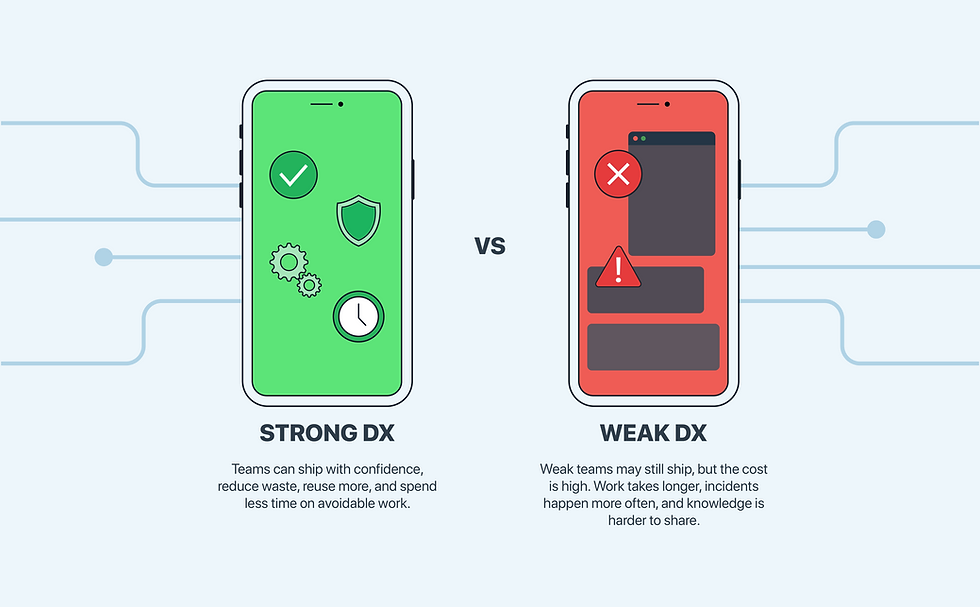
Developer Experience is sometimes framed as a cultural topic or a “developer happiness” topic. In practice, it is a business topic. DX is about how effectively an organization converts engineering effort into stable delivery, predictable execution, and measurable outcomes. When DX is strong, teams can ship with confidence, reduce waste, reuse more, and spend less time on avoidable work. When DX is weak, teams may still ship, but the cost is high. Work takes longer, incidents happen more often, and knowledge is harder to share.
This is why AI adoption produces very different outcomes. AI is a multiplier. It accelerates the delivery model that already exists. It does not create a new one. That means AI will make strong teams stronger, and it will make weak systems harder to manage. AI can help a developer deliver faster, but it can also generate more technical debt, more inconsistent code, and more fragmented decisions if the environment has no standards and no guardrails.
When DX is weak, a common outcome is that teams produce more code but not more value. AI makes output cheaper, but output is not impact. Without clear architecture patterns, shared libraries, and strong conventions, AI-generated changes often require more review time and create more maintenance work later. Another common outcome is that teams ship faster but break more. If testing practices are weak or pipelines are fragile, AI increases risk because it increases the volume of changes that reach production. A third outcome is that AI boosts individual productivity but does not improve alignment. People move faster, but they may still work on the wrong priorities, because AI does not solve decision-making or planning.

At the same time, AI changes the nature of the work itself. It reduces the cost of writing code, but it increases the burden of validating code. Reading and verifying someone else’s code is slower and more mentally draining than writing your own. When code is produced by a model, the reviewer has to validate intent as well as correctness. The question is no longer only “does this compile?” but also “does this match the architecture, the security assumptions, and the product need?” This shifts the bottleneck. The constraint is no longer typing speed or even deploy speed. It becomes comprehension speed.
This is where DX needs to evolve. Good DX is not only automation and faster pipelines. It also means helping teams understand systems and changes faster. That requires readability, traceability, and observability. It requires strong conventions, consistent structure, and good feedback signals when something goes wrong. In an AI-driven workflow, a fast team is not just the one that generates changes quickly. It is the one that can review, validate, and troubleshoot changes quickly.
AI also creates a learning paradox. In many organizations, junior developers grew through entry-level tasks. They wrote boilerplate, fixed simple bugs, added tests, and learned systems by repetition. AI now produces most of that instantly. This changes how teams build skills. If the entry-level tasks disappear, junior developers get less time to build judgment. They may ship sooner, but understand less. Over time, this creates a gap. You get teams that can deliver changes, but struggle to debug, design, and make trade-offs. That is not a short-term issue. It becomes a senior shortage in three to five years.

In an AI-driven environment, DX needs to include intentional learning paths. Juniors need structured opportunities to understand why the system works the way it does, not only how to modify it. They need guided practice in architecture reasoning, debugging, and incident analysis. AI can support learning, but it should not replace the learning process. A strong DX system is not only about output. It is also about building capability.
Another DX pillar becomes more important with AI: context quality. Documentation used to be a support function. In an AI environment, it becomes a dependency. AI assistants are only as reliable as the context they can access. When internal documentation is outdated, the AI does not become neutral. It becomes harmful. It produces answers that look correct but don’t match reality, and developers waste time validating and correcting it. This is one reason why AI can feel like progress while delivery quality stays flat.
This is why knowledge management becomes part of DX. Documentation has to be treated like code. It needs ownership, versioning, review habits, and connection to real systems. The goal is not to write more documentation. The goal is to keep the right context accurate, so teams and tools can trust it. In practical terms, this means that architecture decisions, service boundaries, dependencies, and operational runbooks must be easy to find and regularly updated.
Most companies still use AI as an assistant. But the direction is clear. AI is moving toward agentic workflows, where models take action. For example, AI can update dependencies, fix vulnerabilities, open pull requests, or refactor parts of a codebase without a human writing every line. This changes the risk profile. If AI can act quickly, the organization needs strong safety boundaries. Without those boundaries, the speed becomes dangerous.
Sandbox environments will become increasingly essential. AI agents should run in isolated environments that are safe to break. They should be able to test changes, run quality checks, and produce controlled outputs. Strong DX means enabling that kind of speed without exposing production systems to uncontrolled change. This is not about slowing teams down. It is about making faster change safer.

To make AI a driver of innovation, companies also need to measure the right outcomes. A common mistake is measuring AI success based on activity, such as more commits, more tickets closed, or faster coding. These signals can be misleading. AI can increase activity without improving results. What matters is delivery performance and business impact. Organizations should measure whether lead time improves, whether change failure rates decrease, whether recovery time gets faster, and whether releases become more predictable. They should also measure whether teams spend less time on avoidable work and more time on customer and product outcomes.
The teams that benefit most from AI are not the ones that adopt it first. They are the ones that combine AI with a strong developer environment. AI increases speed, but DX increases confidence. AI makes delivery faster, but DX makes delivery sustainable.
Together, they create the conditions for innovation: faster learning cycles, reliable release practices, stronger technical judgment, and clear alignment between engineering effort and business value.
Innovation is no longer just about tools. It is about the system that makes tools effective. AI is part of that system, but it is not the foundation. Developer Experience is.


